Welcome to this week’s edition of AI, Tech & Money. I’m Kendra Barnett, reporting remotely from my parents’ home in the New Mexico desert today. It’s that delectable, too-short period after the noise of the Upfronts has dulled and just barely far enough out from Cannes to preserve a sliver of mental wellbeing, so I’m trying to soak it all in before the madness truly ensues. This week, SpaceX shares are rallying ahead of a highly anticipated IPO, Uber is having a hard time justifying outlandish AI token rates, Spotify is letting users export short clips of their favorite podcasts, and Meta is testing new paid subscriptions for businesses and creators on Facebook, Instagram, and WhatsApp. Plus, I assembled a basic guide to the burgeoning wild west of agentic advertising and commerce protocols. In adtech. Fully autonomous, agent-led media transactions are becoming a reality. Recently, there’s been speculation about the viability of the Brian O’Kelley-led Ad Context Protocol (AdCP) versus the IAB Tech Lab’s containerized Agentic RTB Framework (ARTF). Will both survive, or will one win out? I asked a few industry insiders. Scroll down to see what they said. As always, replies to this email (even your OOO messages) go directly to my inbox, so feel free to share feedback or tips. Alternatively, reach me at kendra.16 on Signal. |
|
|
If you were forwarded this newsletter, you can sign up here. |
|
|
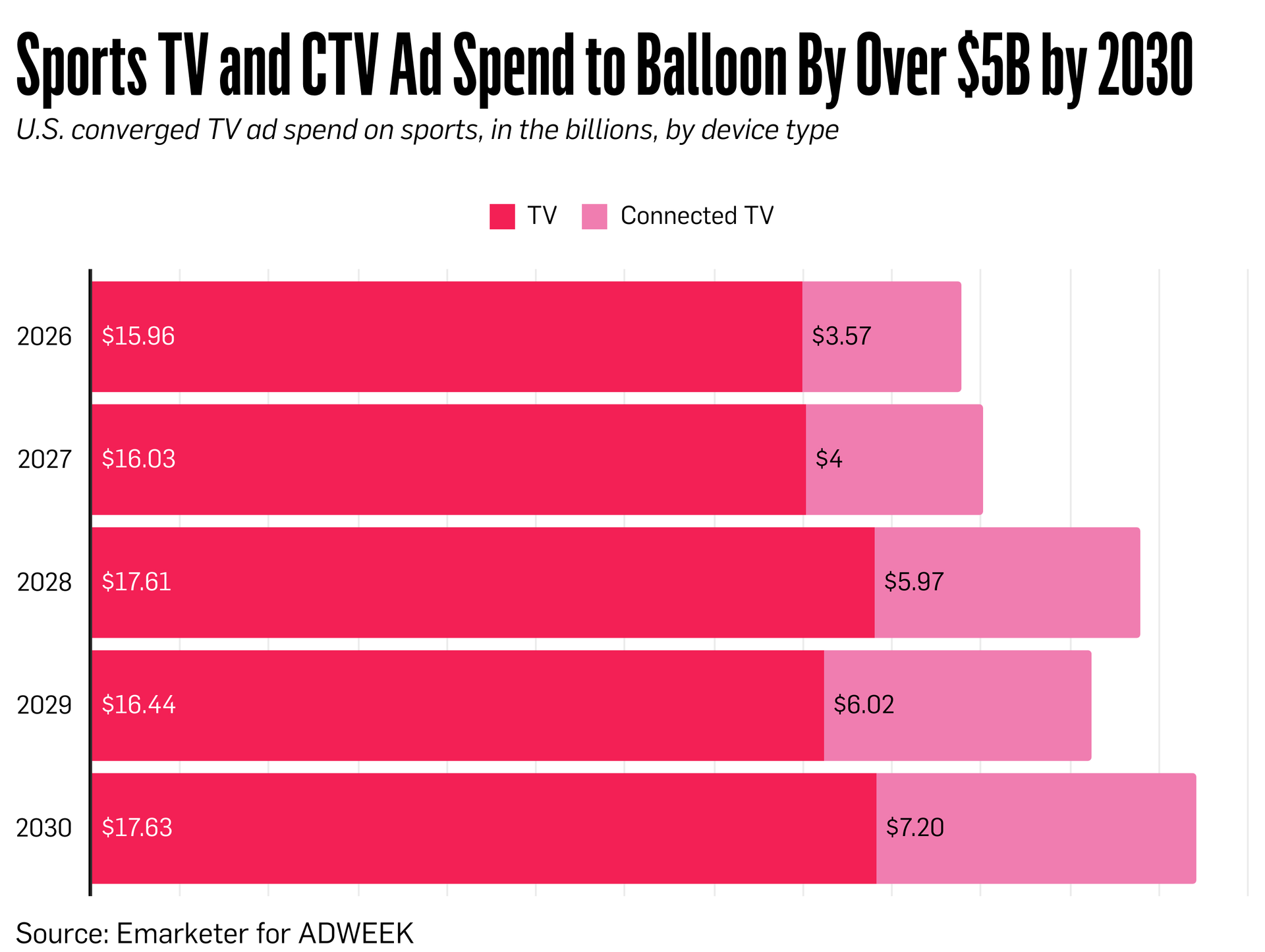
Advertising on live sports content will top $20 billion next year, growing a more rapid clip than the wider TV market, according to new research from Emarketer published exclusively by ADWEEK. In total, advertisers are set to invest an additional $5.3 billion in sports content on TV and connected TV (CTV) between 2026 and 2030. |
|
|
In the Wild West of Agentic Protocols, Will AdCP or ARTF Come Out On Top? |
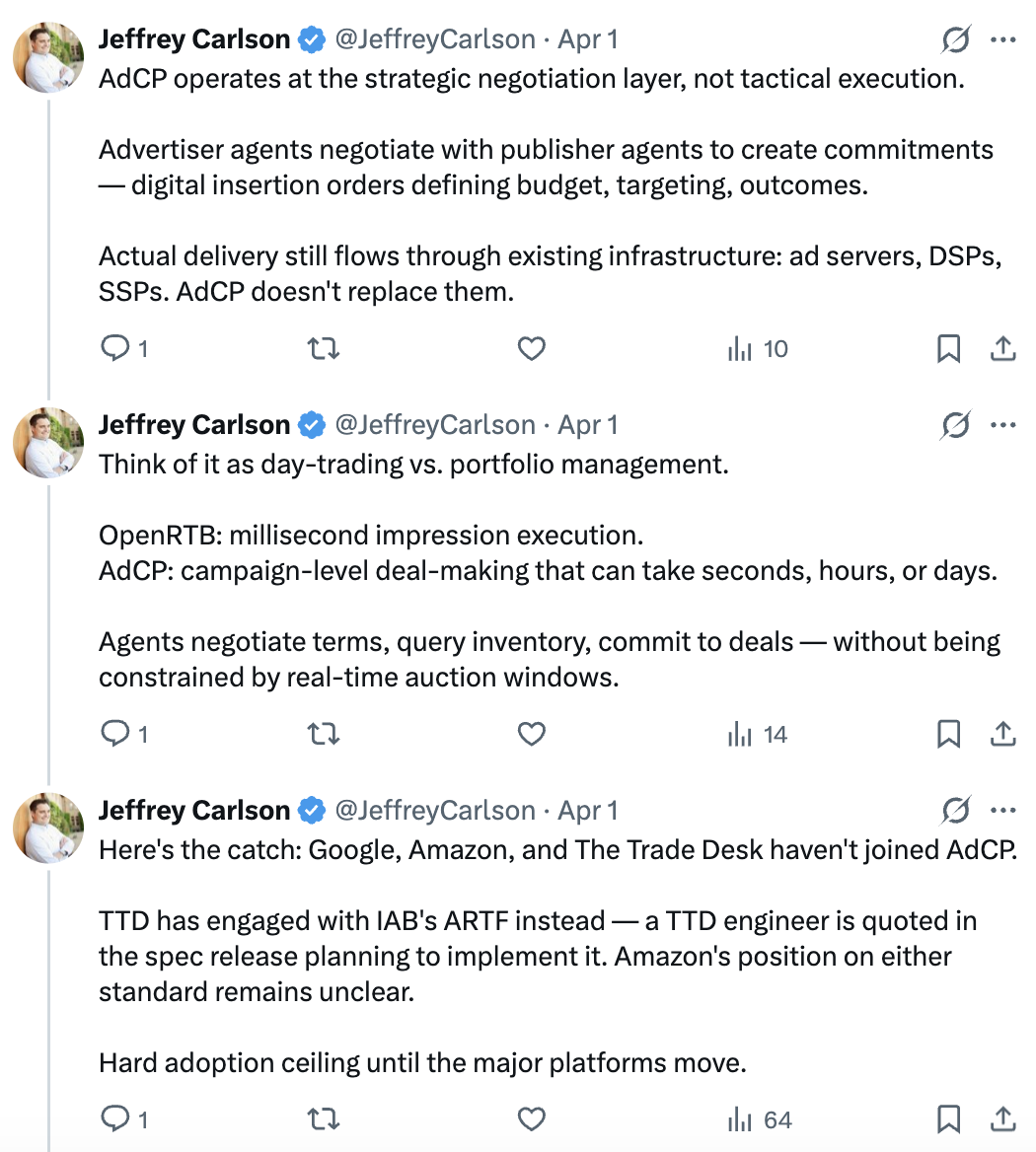
The wild west of agent-to-system and agent-to-agent protocols is upon us. This week, I catalogued more than 10 of the top technical standards, rolled out in the past year-plus, designed to service agentic advertising and agentic commerce. It’s still early days, but real, fully autonomous ad buying, shopping, and payments processing is here. Many of these open standards are built atop the foundations set by two key infrastructure protocols: the Anthropic-made Model Context Protocol (MCP), built to enable agent-to-system interactions, and the Google-made Agent2Agent Protocol (A2A), designed for agent-to-agent interactions. (Both MCP and A2A are now governed by the Linux Foundation). In the realm of agentic media buying, two standards emerged last year in quick succession: Ad Context Protocol, or AdCP, helmed by Scope3 CEO and adtech industry legend Brian O’Kelley, and the IAB Tech Lab-created Agentic RTB (real-time bidding) Framework, or ARTF. Both have gained traction among major industry players; PubMatic, WPP, Triton Digital, and Equativ are members of the former, while Netflix, Paramount, The Trade Desk, and Yahoo have signaled their support for the latter. In some private conversations I’ve had, adtech insiders have said they sense tension between the two approaches and wish the two camps would either come together to back one unified standard or at least merge their efforts to make things simpler for the industry. When I interviewed Katsur and some of ARTF’s founding members back in November, they tried to steer the conversation away from AdCP as much as possible. They suggested to me that they don’t view ARTF as a rival standard to AdCP so much as a complement. ARTF—and the IAB Tech Lab’s wider Agentic Advertising Management Protocols (AAMP) initiative—seeks to simply update the plumbing of modern programmatic advertising through a containerized approach that brings impressions closer to decision-making, thereby reducing latency and making the auction environment more agent-friendly. When established last fall, the protocol was primarily designed to address agentic transactions in open web programmatic auctions. Now, AAMP includes frameworks for agentic direct deals, too. Meanwhile, AdCP, rather than simply giving real-time bidding a facelift, operated originally on the thesis that fully agentic transactions would need to be done primarily via direct-style deals, and would require a fundamentally new kind of infrastructure. It’s since expanded: the spec wants to define how buyer agents discover seller inventory, negotiate terms, execute media buys, and report results in a variety of ways beyond direct deals. |
Some industry insiders believe the two specs are gradually encroaching into one another’s territory. “I look at AdCP and ARTF as two circles of a Venn diagram that overlap more and more the further you get into a 24-month timeline. Today they're addressing different components of the same transaction. But as each evolves, their scope will naturally expand from the middle out,” said Travis Lusk, the senior vice president of enterprise solutions at video ad platform XR Extreme Reach. “Somewhere along the way, our industry decided everything should be an auction and everything should run through a DSP. AdCP challenges that assumption….AdCP says we can have both programmatic and quasi-direct buys. Let the agents work out the best mix,” he explained. “ARTF is a clever solution for managing tech company interactions inside the bidstream. But if AdCP takes off, we become slightly less reliant on the bidstream itself. That's where the friction between the AdCP and ARTF communities lives.” Some have already squarely chosen a side. “We are putting our weight behind real-time decisioning and intelligence operating as close to the impression as possible. That is why we are focused on ARTF and containerized models,” Andrew Casale, president and CEO of supply-side platform Index Exchange said. Index Exchange has independently invested significant resources into building out a containerized solution that invites DSPs to operate their bidder within Index Exchange’s cloud environment, positioned as a means of improving advertising efficiency and cost effectiveness. So, considering the philosophical alignment, it’s not surprising that Index Exchange would opt for ARTF over AdCP. We’ve not yet reached fully autonomous media transactions through this containerized approach at scale, Casale admits. But he’s optimistic about early findings that suggest this kind of model can work, and work autonomously. The next step, he said, “is orchestration: multiple specialized agents working together in real time to make the open internet more intelligent, competitive, and capable of delivering outcomes that rival the largest closed platforms.” That being said, Casale suggested that there may yet be room for AdCP in the ecosystem. “I don’t think every agentic standard is solving the same problem, or that one needs to beat another. Protocols for discovery, intent, governance, planning and workflow coordination will matter.”
And that’s precisely what some experts say AdCP is designed to do—not to compete with ARTF or the IAB Tech Lab’s broader AAMP push—but to handle a different part of the advertising transaction process.
“AdCP is a discovery, planning, negotiation tool,” said Scott Halpert, a programmatic and CTV consultant. “It enables natural language based inventory discovery, campaign planning and deal negotiation. For example, an agency wants to find college educated women, living in the Northeast, who are interested in Caribbean vacations. AdCP would enable the entry of that query on the agency side, the agent would then find publishers that match this criteria and negotiate a deal for said inventory.” But AdCP, at this stage, isn’t equipped to handle execution. Campaigns On the other hand, Halpert said, ARTF is meant to handle services like identity resolution, invalid traffic filtration, and other tasks that can take place at the network level for both the buy- and sell-sides. The colocation of buy- and sell-side tech in the ARTF model, he suggested, could prove particularly valuable for ad insertion in connected TV. But ultimately, he sees AdCP and ARTF operating on two different levels of media transactions. In the future, they could potentially be linked. “ARTF could provide a bridge to AdCP—a service could be built to translate AdCP buys into impression level execution,” he said. But for now, it’s still too early to know. |
|
|
AI, Tech & Money covers the intersection of artificial intelligence, emerging technology, and the business forces shaping them — from groundbreaking research and infrastructure shifts to the investors, startups, and strategies driving the next wave of innovation. Each issue breaks down how new AI developments translate into real economic impact, market opportunities, and competitive advantage across industries. | |
|
|
|