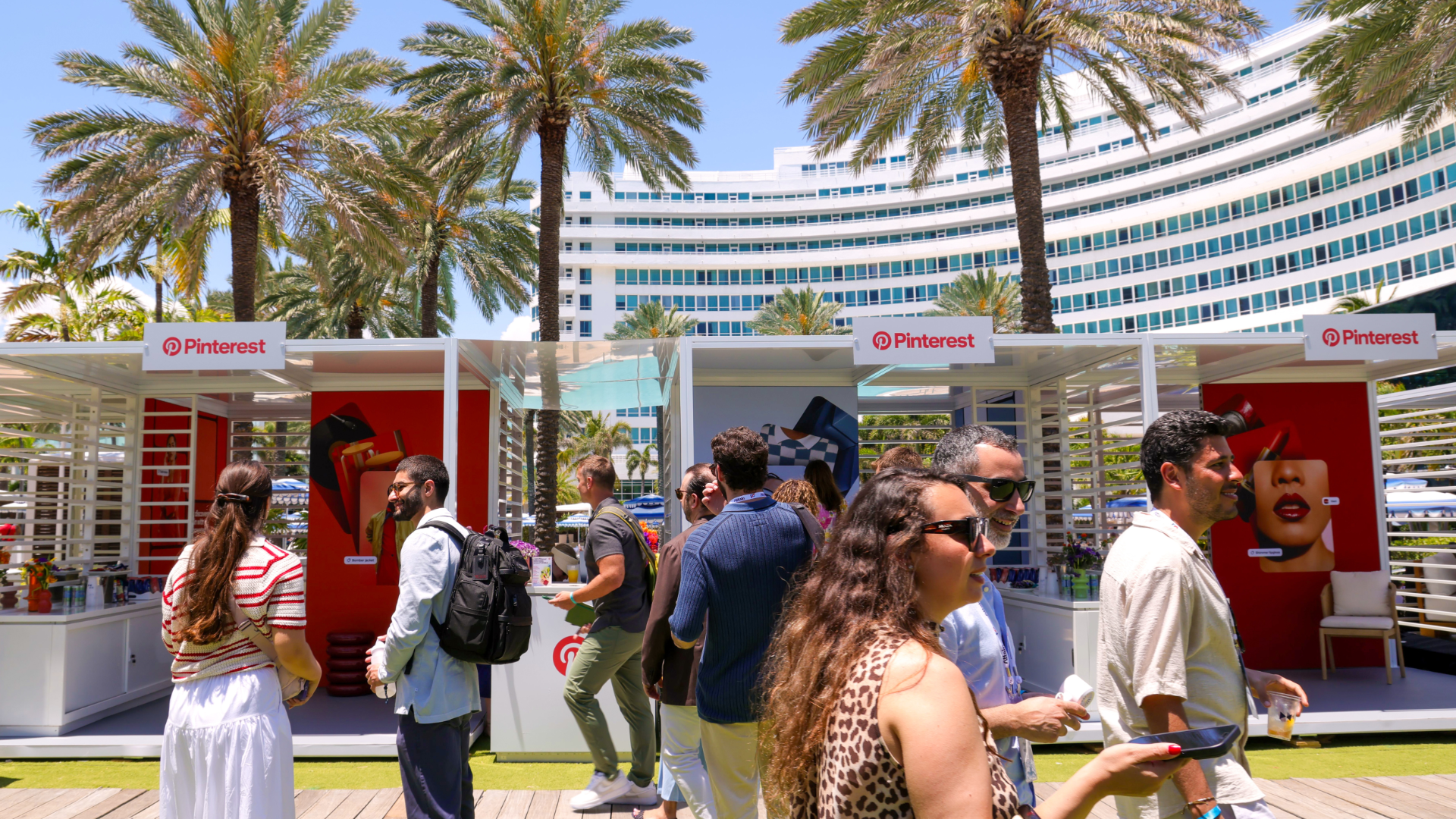
Now in its fourth year, Possible is no longer trying to prove itself. That’s what organizer and Beyond Ordinary Events CEO Christian Muche told me ahead of the event. But the sentiment rang true on the ground this week in Miami Beach, where the event felt more polished and self-assured than in years past.
7,500 attendees came together—a 38% bump from last year—to consume content, network, schmooze, learn, and play. The conference has expanded beyond the Fontainebleau and onto the beach and the neighboring Eden Roc and Nobu Hotels, all while its lineup of branded yachts on the west side of Collins Ave grows longer. Programming included a new invite-only forum for CMOs, a dedicated creator marketing track, and an AI-focused space. Select content was also distributed online via a new partnership with YouTube.
Of course, as with most advertising gatherings, there were drinks and drama: M&A pros Terence Kawaja and Michael Kassan went head-to-head at Digital Fight Club, and DailyMotion’s yacht activation caught on fire on Monday evening, ICYMI.
My week was more tame. I moderated a panel at ADWEEK House on navigating AI slop with leaders from Crispin, Silverpush, and Best Friends Animal Society, and also sat down for a fireside with Index Exchange’s Andrew Casale and Bedrock Platform’s Shane Shevlin to unpack Index Exchange’s decision to welcome DSP bidders into its platform.
Outside of those commitments, my time at Possible was largely spent in meetings with top adtech and media leaders, where I learned more about their strategic plans and tried to draw out the moods and themes defining this moment in the industry. Here are some of the biggest throughlines from those conversations.
1. The Industry is Still Trying to Solve for Fragmented Measurement
Across conversations, leaders emphasized that media measurement remains highly fragmented and imperfect. There’s widespread understanding that historical approaches to measurement—whether it be Nielsen-style panels, marketing mix modeling (MMM), or multi-touch attribution (MTA)—are often insufficient on their own.
Incrementality, the practice of quantifying the real causal lift generated by a campaign, is emerging as a promising new focus area for some players. The limitations of MMM and MTA contributed to Smartly’s decision to acquire measurement firm Incrmntal, Smartly CEO Laura Desmond told me.
Meanwhile, Viant just snapped up panel-based measurement firm TVision for $40 million in an effort to establish a more unified view of media metrics. It’s a move they hope will bring advertisers a more cohesive look at performance across linear, CTV, and walled gardens like YouTube and Prime Video.
2. TV’s Shift: Linear is Not Dead Yet and Performance Comes to the Big Screen
More than 80% of all television ad impressions come from linear, according to recent research from iSpot. This suggests that the buzz around cord-cutting is somewhat overblown. On the ground at Possible, adtech insiders from Tatari, NBC Universal, and Teads suggested they’re still putting a premium on linear TV, particularly when it comes to one of the channel’s longtime strongholds: live programming.
One insider told me we are “years away” from the Super Bowl, for example, being bought purely programmatically, because TV networks don’t want to risk a technical mishap. Meanwhile, advertisers still see the value of linear, and linear live programming in particular, where they’re able to reach masses of engaged viewers at once.
But neither linear nor streaming TV can remain a solely upper-funnel play, multiple experts told me. With the emergence of new interactive ad formats and increasing demand for end-to-end advertising solutions, the TV screen is becoming a place for performance marketers, too.
I had lunch at Possible with some folks at BrightLine who are investing heavily in gamified ad formats which could help drive lower-funnel engagement and conversion. Meanwhile, Teads’ new CMO Dani Cushion told me the adtech firm is piloting a new performance-focused CTV offering.
“All the linear and streaming companies…in this next generation, have to be deeply committed to a technology stack that does drive performance,” Smartly’s Laura Desmond said.
3. The DSP-SSP Wars Are Intensifying as the Buy and Sell Sides Converge
The lines between demand-side platforms (DSPs) and supply-side platforms (SSPs) continue to blur as many DSPs introduce sell-side tools (like The Trade Desk’s OpenAds), while SSPs roll out buy-side tools (like Magnite’s shiny new media buying agent and PubMatic’s AI-powered buying platform). Are the two sides converging and becoming one, or is one side or the other facing a deeper threat of extinction? Opinions were divided on the ground at Possible this week, but the tension between the buy and sell sides of the business felt undeniable.
One DSP leader said they believe that SSPs could be facing an existential threat because “SSPs don’t have a full view into the pathways of how consumers work.”
SSPs may also have a harder time competing in CTV specifically, two other leaders at a different DSP said, because they have traditionally made money by helping lots of small publishers sell ad space more efficiently—bundling up the long tail of publisher inventory to generate revenue. But that model breaks down in CTV because there are far fewer publishers in CTV, so there’s less need for supply aggregation and the long tail is essentially nonexistent.
At the same time, these leaders see a clearer bifurcation in the value of different DSPs today. Big players like Amazon and Google secure their advantage through owned inventory, while smaller DSPs can differentiate through exclusive data.
Bonus theme #4: Everyone is building proprietary AI agents (and many companies are welcoming third-party agents via API or model context protocol plug-ins). How many will find adoption and scale is an open question.