Hi all, and welcome back to On Background, my weekly newsletter chronicling the rapidly transforming digital media industry. I’m writing to you again from our sunny Union Square office, a week before the hordes descend upon the city for Advertising Week.
Yesterday I had the pleasure of attending the IAB Podcast Upfront, which featured appearances from all the classic denizens of the podcast circuit—Charlamagne tha God, NPR, and iHeart—as well as some welcome new additions, including former NFL quarterback Cam Newton, creator Lele Pons, and the folks from Jomboy Media, whose appearance coincided with the Yankees’ first-round playoff game (and subsequent loss) to the Red Sox.
The Upfront was enlightening for a variety of reasons, although it was most notable for what was absent: any discussion of AI. Below, I explore how the technology is and isn’t transforming an industry that thinks of itself as relatively immune from its disruption. But first, a few pieces of news you should know about. As a reminder, replies to this email go straight to my inbox, so please feel free to reach out with feedback, tips, or extremely good pitches. |
|
|
If you were forwarded this newsletter, you can sign up here. |
|
|
The Dispatch Also Monetizes: The conservative publisher The Dispatch is on pace to generate more than $7 million in revenue this year, with 80% of its business coming from subscriptions, according to president Mike Rothman. The Dispatch’s SCOTUSblog Summit, held last week and themed around the legal blog it acquired earlier this year, generated a mid six-figure revenue from sponsorships, Rothman said. The success of the venture—its first event—has prompted The Dispatch to unveil a new series of regional events, called Dispatch Town Halls, beginning this month. - Food52’s New Hires (SCOOP): The food and lifestyle publisher Food52 named Heidi Robinson its new CFO and COO, according to an internal memo I obtained. (Former COO Claudia Huapaya left in May.) The publisher also promoted Chris Finley to chief supply chain officer. I reported in March that the company hoped to bring in $60 million in total revenue this year—roughly half the business it did in 2021—after slashing its headcount by 40%.
- Free Press to CBS: Paramount is set to formally announce its acquisition of the conservative iconoclastic outlet The Free Press “in the coming days,” according to Status, although the final price has not been disclosed. As part of the deal, Free Press founder Bari Weiss would lead CBS News, an installation sure to rankle some at the storied news broadcaster.
- ‘Make Sure Your Kids Are Nepo Babies’: The financial publisher MarketWatch launched the first brand marketing campaign in its 28-year history on Tuesday, I reported. The creative is intended to target Gen Z audiences interested in personal finance. To do so, it dispenses tongue-in-cheek mantras like “Make sure your kids are nepo babies” and “Money doesn’t grow on salaries” in neon-green text. The effort is meant to capitalize on the success the publisher has seen with its subscription business, which editor in chief Mark DeCambre told me has doubled to the mid six digits since 2022.
- People Inc. Digests Feedfeed: The company formerly known as Dotdash Meredith snapped up a social food publisher called Feedfeed on Wednesday for an undisclosed amount. The 12-person staff will join People Inc. with a remit to share its social know-how with the rest of the media company’s food portfolio, which includes AllRecipes, Food & Wine, and Serious Eats. The move also telegraphs the ongoing broader transformation afoot at People Inc., one of the largest digital media companies in the world, as it adjusts its editorial strategy to account for dwindling search and social traffic.
|
|
|
Change the Game This Football Season |
Football is more than a game — it’s loyalty, rivalry, and passion that brings fans together week after week. With PREMION’s 100% CTV Football Packages, your brand can connect with the most engaged audiences across both the NFL and NCAA. From regular season rivalries to playoff showdowns and the march to championships, PREMION puts your message at the heart of the action — live, premium, and on the biggest screen in the house. Learn more at PREMION.com. |
| |
THE LEDE: AI Is Disrupting Everything. Why Not Podcasting? |
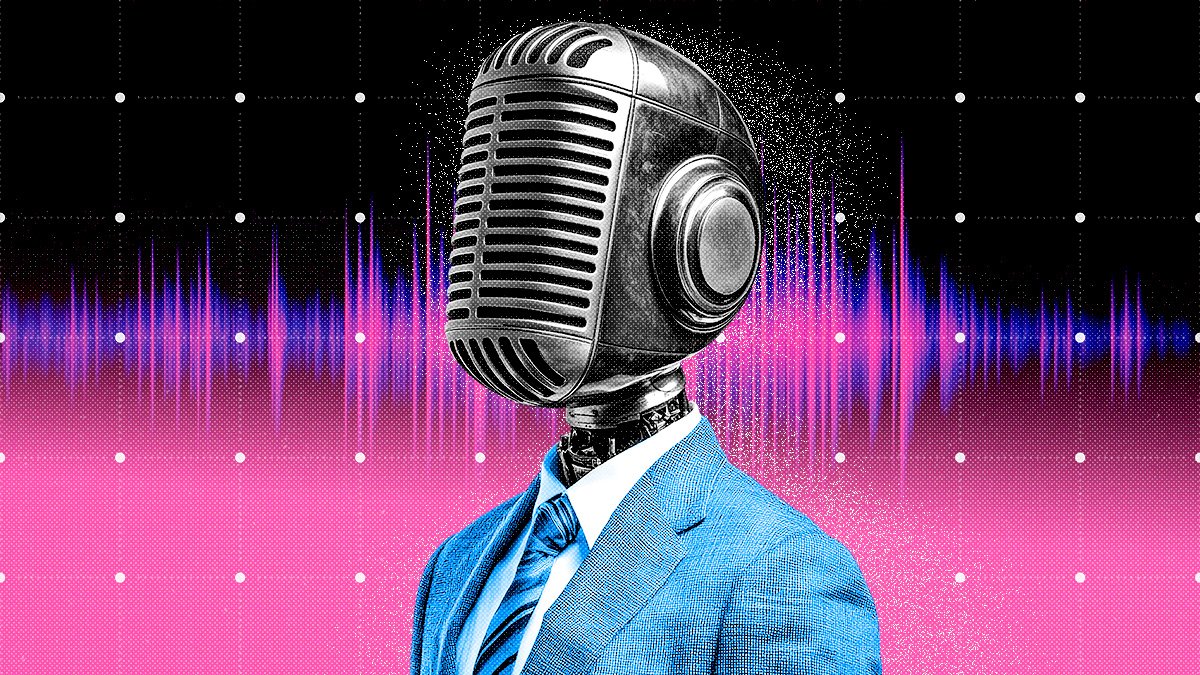
At the IAB Podcast Upfront in Midtown Manhattan on Tuesday, scores of media executives, celebrities, audio creators, and adtech vendors graced the stage to extol the virtues of podcasting.
In a series of presentations interspersed with frenzied networking breaks, panelists hit all the classic talking points: the intimacy of the medium and the efficacy it affords for advertisers; the challenges and opportunities in measurement; the need to embrace a multipronged commercial strategy; and, of course, the embrace of video that’s begun to transform the entire medium.
One topic, however, was conspicuously absent: artificial intelligence. If the technology came up at all, it was as a tool to achieve backend efficiencies, such as creative optimization, audience targeting, and streamlined editing—not as a threat to the industry, nor in any way part of the actual process of creating the podcasts themselves.
As an unfortunate regular of the conference circuit, I can hardly overemphasize how unusual this is. Nearly every media industry event I attend immediately devolves into a parlor game of AI bingo, with the audience and panelists all waiting patiently for the subject to arise and subsume the rest of the conversation. In every other part of publishing, there is no more pressing subject matter and no greater object of hyperfixation than AI.
To compound the oddity, news of a controversial startup in the audio space has recently worked the industry into a lather. Called Inception Point AI, the company has made headlines by championing a strategy predicated on using AI-generated personalities to create podcasts, with the broader goal of turning the personalities into influencers.
The Hollywood Reporter article introducing the startup—“5,000 Podcasts. 3,000 Episodes a Week. $1 Cost Per Episode”—set off a firestorm of indignation, with thought leaders and executives in the audio industry decrying the output as “slop.”
Set against the backdrop of this uproar, the exclusion of AI from any of the Upfront programming was particularly baffling. Clearly the barbarians are at the gates. Just as ChatGPT transformed text-based production when it was introduced two years ago, the debut of Inception Point, and the launch this week of both Meta’s and OpenAI’s AI-generated social video feeds, feels like an inflection point.
‘Carbon-based’ creators
Just like its predecessor, the mission and methodology of Inception Point have been roundly criticized. Several audio executives I spoke with insisted that the intrusion of AI into the world of podcast creation would be limited to the fringes, if at all.
Their arguments border on the sentimental. If you’ve ever spoken with anyone involved in professional podcasting, the craft can be discussed with the kind of reverence that most people reserve for houses of worship. The words authenticity, connection, intimacy, and even magic come up frequently. It can get very woo-woo.
And yet, do you have a favorite podcast? As treacly as it sounds, the medium does yield a sense of intimacy unlike any other, one often rooted in a sense of connection that the listener has with the host. As a result, its practitioners are confident—adamant, almost—that it will be largely spared from the ravages of AI.
“It’s obvious that creators need to be carbon-based organisms,” said Greg Glenday, CEO of the podcast company Acast. “We use AI around the edges, but our pitch to advertisers is authenticity. That is our moat and our five-year plan.”
Others echoed the sentiment that AI poses less of a threat to podcast hosts than it does to writers or even video creators.
“As long as podcasting remains something people think of as an authentic experience,” said Matt Shapo, the director of digital audio and video at the IAB, “I’m not sure we’ll ever have the same level of disruption when it comes to content production.”
There are exceptions, of course.
Certain genres of podcast are likely to be outsourced to AI, the same way commodity text content has been replaced by ChatGPT. Podcasts recapping sports games, detailing the weather, or offering a synopsis of a news article are already popular use cases for the technology. In these cases, according to Glenday, listeners have a connection to the content, not the creator.
“Commodity podcasting—news, weather, daily rundowns—could be replaced,” said Alison Tucker, an associate director of audio investment at Omnicom Media Group. “But basically everything else? That’s much harder.”
The divide is reflective of a wider trend reshaping digital media. As AI dramatically reduces the effort required to create generic content, publishers and consumers are increasingly gravitating toward creator-led content, where personality can distinguish it from the deluge of information now inundating the web.
Robot callers
Still, the confidence among podcasters is disorienting, as AI has engendered existential dread into nearly every other sector of the economy.
That optimism—misplaced or otherwise—is also exactly where Inception Point sees its opportunity, according to CEO and cofounder Jeanine Wright.
The idea for the company came from the pandemic, when cofounder William Corbin created a popular podcast, called Covid 411, simply by reading the daily CDC update into a mic. The series spurred Corbin to think about other ways to make timely content that people want with low production costs, Wright said.
While the ambitions of the startup are broader than podcasts, the company started with the medium because the technology surrounding synthetic audio is already advanced enough that it’s difficult to tell the difference between a real and artificial voice.
By combining that capability with timely subject matter, the company aims to produce quick, low-lift audio products that only need to find a small audience to recoup their minimal costs. Already, Inception Point has more than 4,000 of these AI-generated shows, publishing thousands of episodes a week, on podcast platforms including iHeartMedia’s Spreaker. (Some of the flash-published series include biographies of zeitgeist subjects including Austin Butler, Ozzy Osborne, and Charlie Kirk.)
The strategy positions the company to own the niche of commodity audio content that podcast executives have conceded is already susceptible to bot-sourcing. The larger question is whether audiences will embrace its entertainment output, which the company plans to expand to feature a cast of AI-generated personalities in conversation with one another, discussing real and fictional subjects through the filters of their lab-designed personalities.
“Most of the pushback is because people have not stayed on the cutting-edge of AI development,” Wright said. “If people say that AI creators will never be able to get to the emotionality of a human creator, I think they don’t understand the capabilities of the tools today and where they will be in the future.”
That such a product could ever take off admittedly feels like a stretch. And yet, by now I am loath to bet against the steady advance of AI into every crevice of creative output.
So who is right: the podcast professionals betting on their moat of authenticity, or the Hollywood startup farming out its editorial to bots?
“I do have a bit of anxiety,” Glenday said. “Sometimes, you get nervous when everyone agrees.”
|
|
|
“[Legacy news publishers] hold back partnering or letting their journalists do new kinds of journalism, and then you’ve got people who aren’t beholden to legacy norms, values, journalistic principles, who rush into these places and build a huge following.” |
— Journalist Peter Hamby on the TikTok journalist Aaron Parnas READ MORE |
|
|
“You know where I listen to it? I listen to it on social media. I listen to pieces and pieces.” |
— Pivot cohost Kara Swisher on how she listens to The Bulwark READ MORE |
|
|
“We are exiting, on a compressed timeline, people where reskilling, based on our experience, is not a viable path for the skills we need.” |
— Accenture CEO Julie Sweet on an earnings calls, explaining the rationale behind laying off 11,000 employees in three months READ MORE |
|
|
“This blew up, if you're curious obviously we had ventilation for the smoke and a kill switch to cut off the fires." |
— Mr. Beast defending his recent video, which involved trapping a man in a burning building for $500,000 READ MORE |
|
|
Jeanine Wright is the cofounder and CEO of Inception Point AI, a startup building a stable of AI talent to host podcasts, with the broader goal of turning the personalities into influencers across social media and more. Mark Stenberg: Your company has unnerved much of the podcast industry, which is appalled at the idea of AI-generated hosts producing podcasts. What makes you think this will work?
Jeanine Wright: All of the industries that think there is something sacred about their industry, that AI will not be able to disrupt it—those are the areas most ripe for disruption. In the podcasting space, rigid thinking has prevented us from embracing the new and different. We let the people decide. The overwhelming majority of our shows are finding a listening audience.
Mark: What kinds of podcasts can you produce using AI-generated hosts?
Jeanine: The old world thinking was that you produce a big show then find an advertiser to sponsor it. We think of ourselves as closer to Wikipedia or Reddit in that we can serve niche communities at scale. Our most popular genres are audiobooks, lifestyle content, flash biography, and audio information updates, like sports scores and pollen reports.
Mark: What do you think of the argument that people will never gravitate to podcasts not hosted by humans?
Jeanine: What is the most popular genre of books? Fiction. People are quick to engage in alternate worlds, like animation. We design all our voices from scratch, which means I can program them to speak in rich colloquialisms and design their emotionality.
Mark: Is it true that your cofounder used ChatGPT to convince you to join the company?
Jeanine: My cofounder William Corbin reached out to me this summer and said that he put all of his LinkedIn contacts into ChatGPT and asked who his cofounder should be. ChatGPT suggested me, so he asked me to lunch. He then used it to generate a list of points to convince me to take the job, and it worked. |
|
|
Mark Stenberg is Adweek's senior media reporter covering the business of digital and print media and publishers, including their advertising, marketing and editorial strategies. Before joining Adweek Mark was a reporter for Business Insider. | |
|
|
|